
7 Best Exercises for Pelvic Stability at Home

A pelvis that feels unsupported can make ordinary movements surprisingly demanding. You may notice it when climbing stairs, getting up from a chair, turning in bed, running, carrying shopping or standing on one leg to put on your shoes. The best exercises for pelvic stability are not necessarily the hardest ones. They are the movements that help you coordinate your breath, trunk, hips and legs with calm, controlled effort.
Pelvic stability is not about holding your body rigid or constantly tensing your pelvic floor. It is about creating enough support for movement, then allowing the right areas to move freely. This can be particularly helpful if you are returning to activity after time away, building confidence following an injury, or simply want your daily movement to feel steadier and more comfortable.
What pelvic stability really means
Your pelvis is the meeting point between your spine and legs. For it to work well, the deeper abdominal muscles, pelvic floor, diaphragm, hip muscles and lower back need to share the workload. If one area is doing too much - for example, gripping through the buttocks, holding your breath or over-arching your back - movement can start to feel strained rather than supported.
Good stability is therefore active and adaptable. During a walk, for instance, your pelvis should make small natural movements while the muscles around it control the shift from one leg to the other. During a squat, it should remain well aligned without you forcing it into an exaggerated tuck.
The exercises below build this control progressively. Work slowly enough that you can notice what your body is doing. Quality matters more than repetitions, especially at the beginning.
Before you begin: a few useful cues
Choose a quiet space and wear clothing that lets you move comfortably. Aim for a gentle effort, rather than a maximum squeeze. You should be able to breathe throughout every exercise and speak in a full sentence if needed.
A useful starting position is to let your ribcage sit over your pelvis, with both feet evenly grounded. Avoid trying to flatten your lower back into the floor or standing with your bottom tightly clenched. Think of lengthening through the crown of your head while allowing your shoulders and jaw to soften.
If an exercise causes sharp pain, increasing discomfort, a feeling of heaviness or pressure in the pelvis, or symptoms that concern you, stop and seek individual advice. People who are pregnant, recently postnatal, managing pelvic pain or returning after surgery may benefit from a more tailored starting point.
7 best exercises for pelvic stability
1. Supported diaphragmatic breathing
Lie on your back with your knees bent and feet on the floor, or sit upright in a supportive chair. Place one hand around the lower ribs and the other low on your abdomen. Breathe in gently through your nose, allowing the ribcage, abdomen and pelvic floor to soften and expand naturally. As you breathe out, imagine your lower tummy gently drawing in, as though fastening a comfortable pair of trousers.
Do not force a pelvic-floor squeeze. The aim is coordination: a relaxed inhale and a light, responsive exhale. Try six to eight unhurried breaths. This is a valuable foundation because breath-holding can make many strengthening exercises feel harder and less controlled.
2. Heel slides
Stay on your back with knees bent. Find a comfortable neutral position for your pelvis, somewhere between an exaggerated arch and a hard flattening of the lower back. Breathe out gently, engage your lower abdomen at a light level, then slowly slide one heel away along the floor. Keep the movement small enough that your pelvis does not tip or twist.
Bring the heel back in on an inhale and change sides. Complete six to ten repetitions per side. If your back arches, your ribs flare upwards or you feel strain through the hip flexors, shorten the slide. Control is the exercise here, not how far your leg travels.
3. Glute bridge
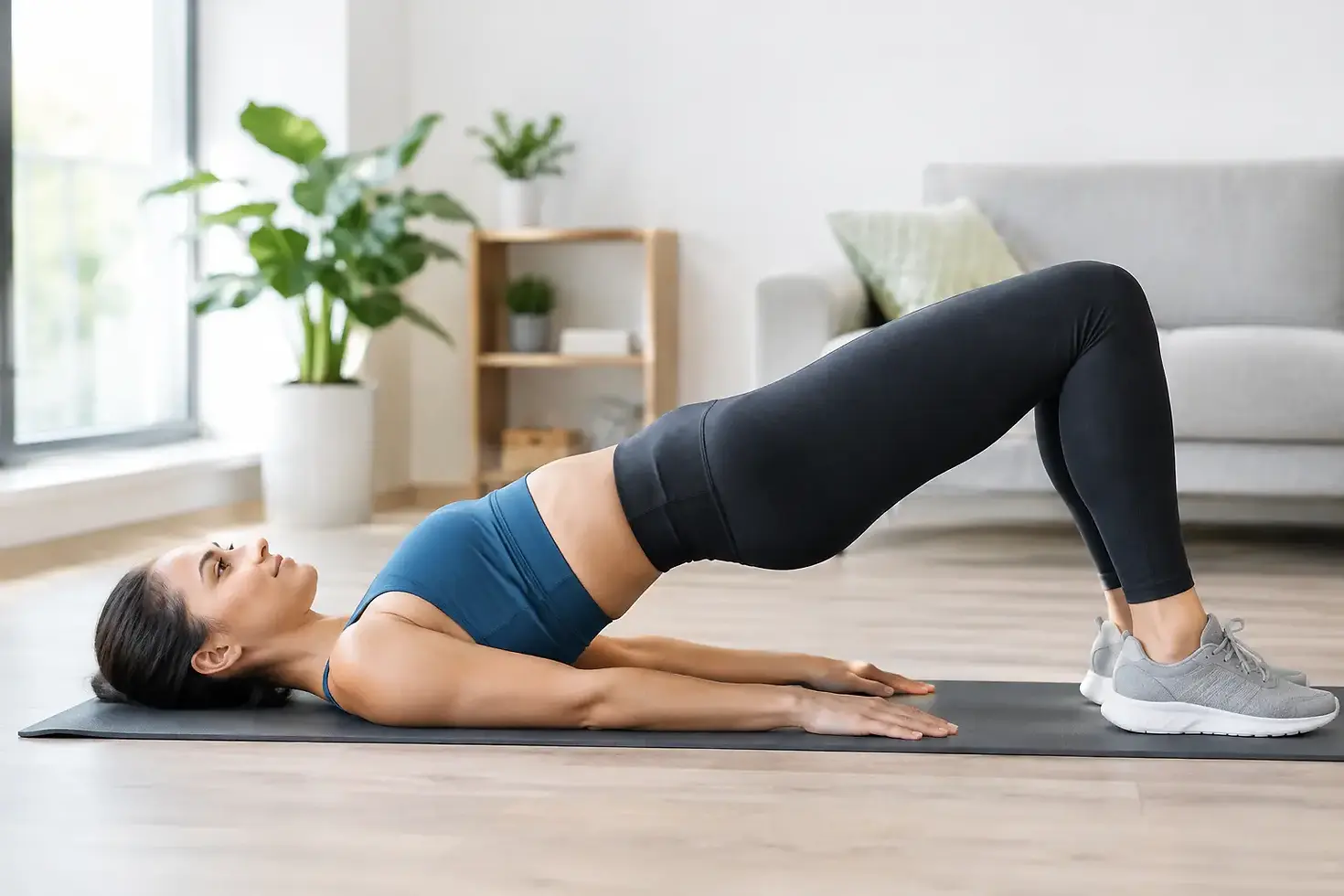
With both feet hip-width apart, press gently through your feet and lift your hips until your body forms a comfortable line from shoulders to knees. Your ribs should stay soft rather than thrusting upwards. Pause for two slow breaths, then lower with control.
Try eight repetitions. You should feel the buttocks and back of the thighs working, not a pinch in the lower back. A bridge helps build hip extension strength, which supports activities such as walking uphill, rising from a chair and climbing stairs. If both feet feel easy and steady, progress by briefly lifting one heel at a time while keeping the pelvis level.
4. Side-lying clam
Lie on your side with hips and knees bent, feet together and your head supported. Keep your pelvis stacked rather than rolling backwards. Without moving your feet apart, open the top knee only as far as you can maintain that steady position, then lower it slowly.
Aim for eight to 12 repetitions on each side. You may feel this in the side of the hip or upper buttock. These muscles help control the pelvis when you are balancing on one leg, whether you are walking, running or stepping off a kerb. If you feel the front of the hip gripping, make the range smaller.
5. Bird dog reach
Start on hands and knees, with hands under shoulders and knees under hips. Imagine balancing a glass of water across your lower back. Extend one leg behind you, keeping the toes pointing towards the floor, then return. Once that feels stable, reach the opposite arm forwards at the same time.
Hold for a slow breath, then change sides. Six controlled repetitions per side is plenty. Resist the temptation to lift the leg or arm high. A long reach, with minimal rotation through the pelvis and trunk, is more useful than a dramatic one.
6. Step-down or controlled sit-to-stand
For a practical standing exercise, begin with a sit-to-stand from a firm chair. Place your feet beneath you, lean forward slightly from the hips and stand without letting your knees collapse inwards. Lower yourself back to the chair slowly, as if you are trying not to make a sound.
Complete eight to 10 repetitions. When this feels comfortable, try a low step-down: stand on a small step and slowly tap the opposite heel to the floor, keeping the standing knee tracking roughly over the middle toes. This develops the single-leg control your pelvis needs in everyday life. Use a wall or banister for support if balance is uncertain.
7. Suitcase carry
Hold a light weight, such as a small shopping bag or dumbbell, in one hand. Stand tall and walk slowly for 20 to 30 seconds without leaning towards or away from the weight. Keep your breathing easy and your shoulders level, then switch sides.
This simple carry asks the muscles around your trunk and pelvis to respond to an uneven load, much like carrying a bag, a child or gardening equipment. Start lighter than you think you need. If you feel yourself hiking one hip or holding your breath, reduce the weight or shorten the walk.
How often should you practise?
For most people, two or three short sessions a week is a sensible place to begin. You might select three exercises one day and three or four on another, rather than trying to complete everything at once. A brief breathing practice can be used more often, particularly before a walk, gym session or busy day.
Progress only one element at a time: add a couple of repetitions, slow the lowering phase, increase the time under control or introduce a slightly more demanding variation. More intensity is not always better. If your movement quality declines, return to the previous level for a week or two.
When personalised support can help
General exercises are a helpful starting point, but the right approach depends on your posture, movement habits, training goals and symptoms. For some people, hip mobility or foot and ankle control will need attention alongside pelvic stability. For others, stress, fatigue and shallow breathing may be making it difficult to relax enough to create effective support.
At Laura Fishlock Osteopathy, movement guidance can form part of a personalised plan that considers the whole body, not simply the area that feels uncomfortable. For people in Hungerford, Newbury and the surrounding area, this can provide a supportive route back to steadier movement and greater confidence in everyday activities.
Start with the version of each exercise that feels calm and achievable. The goal is not to brace your way through life, but to help your body trust its own ability to move, adapt and support you well.


Comments