
Holiday-Ready Bodies: How to Travel, Walk More, and Sit in Cars and Planes Without Flare-Ups


You've been counting down the days. The bags are packed, the itinerary is set, and the last thing you want is for your back, hips, or neck to be the thing that defines your holiday.
For many people, travel itself is the trigger. Hours in the car, a long-haul flight, then suddenly walking miles on cobbled streets when your usual day barely takes you beyond a desk and a car park. It's a significant physical transition — and without a little preparation, it's one your body can struggle with.
The good news is that flare-ups during travel are largely preventable. This guide covers what actually happens in your body during travel, how to prepare before you go, how to manage in-transit, and how to navigate the jump in activity that holidays demand — so you can enjoy every part of the trip.
Why Holidays Trigger Flare-Ups (It's Not Bad Luck)
Two things tend to cause problems around holidays, and they sit at opposite ends of the same spectrum.
The first is sustained static load — the prolonged sitting of a long drive or flight. Your hip flexors shorten, your spinal discs experience sustained compressive or tensile load, the deep stabilising muscles of your spine gradually switch off, and your thoracic spine stiffens. By the time you arrive, you're not just tired; you're structurally compromised for the next few hours.
The second is sudden load increase — the activity spike. You may walk 2,000 steps on an average Tuesday. On day one of a city break, you walk 18,000. Your joints, tendons, and muscles haven't had time to adapt. Inflammation follows. The Achilles that's been grumbling quietly makes itself known. The knee that "only hurts on stairs" suddenly has a lot of stairs to deal with.
Understanding these two mechanisms gives you a clear strategy: buffer the sustained load, and graduate the activity increase. Everything else flows from there.
Before You Go: The Week That Matters Most
The most effective preparation for holiday travel happens in the seven days before you leave, not the morning of departure.
Prioritise sleep and hydration. Both are fundamental to tissue resilience and your body's ability to tolerate load. Spinal discs in particular are largely avascular — they rely on movement and hydration to exchange nutrients. Well-hydrated discs handle compressive load significantly better.
Move daily, even briefly. If you know you'll be travelling, the worst thing you can do in the lead-up is become increasingly sedentary as you rush to clear your work inbox. A 20-minute walk each day in the week before travel maintains tissue mobility and keeps your movement patterns active.
Identify your vulnerability. Is it your lower back? Your neck? A hip? Know your history and be honest with yourself about where you're likely to feel it first. This shapes the specific preparation and in-transit strategies that will be most valuable for you.
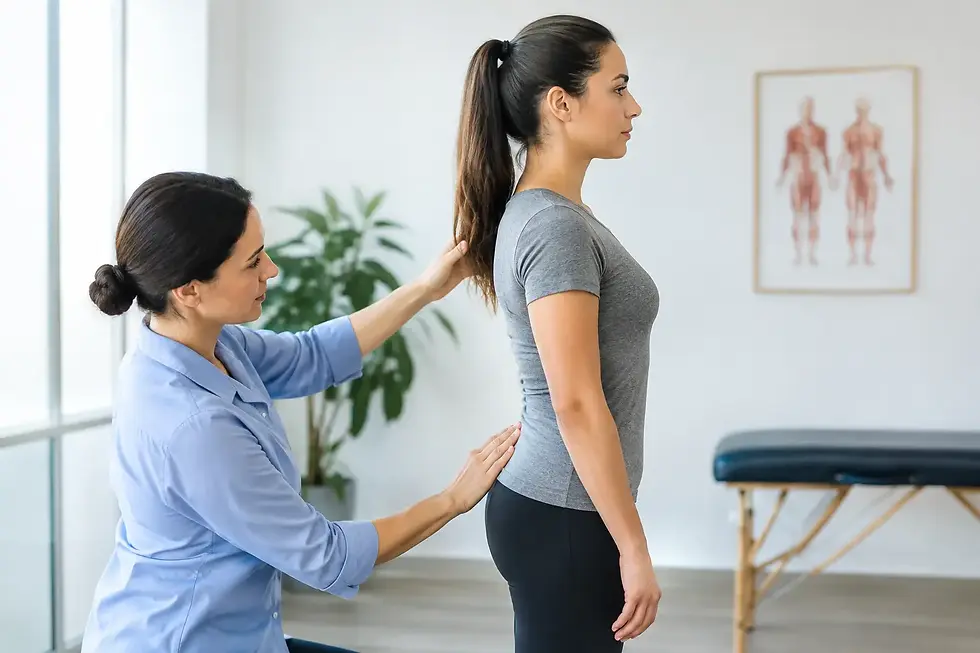
If you have a known issue, consider a pre-travel appointment. Having your body assessed and any restrictions addressed before a long journey is far more straightforward than managing an acute episode on the road. A manual treatment in the days before departure can make a meaningful difference to how your body tolerates sustained travel.
In the Car: Making Long Drives Work for Your Body
Car travel is one of the most biomechanically demanding things we do without realising it. You are held in hip flexion, your lumbar spine is often flattened or unsupported, vibration transmits directly through the spine, and the foot on the accelerator creates a sustained asymmetry through the pelvis and lower back.
Set your seat up properly before you move. Your hips should be approximately level with or very slightly higher than your knees. Your lumbar spine should be supported — not forced into extension, but gently encouraged into its natural curve. A small rolled towel or a dedicated lumbar roll placed at the curve of your lower back (not mid-back) makes a significant difference on longer journeys. Your headrest should sit at the level of the back of your skull, not your neck.
Break every 60–90 minutes without exception. This is not a luxury; it is a physical requirement for disc health and soft tissue function. At each stop, don't just stand — actually move. Walk 3–5 minutes. Do 10 hip circles each side. Reach your arms overhead. These take less than five minutes and reset the spinal load cycle effectively.
Drive breaks exercises (take 3–5 minutes at each stop):
Hip flexor stretch: step forward into a lunge and gently squeeze the glute of the back leg. Hold 45 seconds each side.
Standing thoracic rotation: hands on hips, feet hip-width. Rotate slowly through your mid-back, 10 reps each way.
Calf raises: 15 slow raises on each leg, heel fully lifting. This promotes circulation in the lower legs and reduces the risk of stiffness and swelling.
Overhead reach: interlace fingers, turn palms up, and reach both arms overhead. Breathe into the stretch. Hold 20–30 seconds.
If you're travelling with passengers, use the driving position rotation where possible. Even one hour of being a passenger rather than the driver changes the load pattern meaningfully.
On the Plane: Managing Long-Haul and Short-Haul Flights
Aircraft seating is typically designed around space efficiency rather than spinal health. Seat depth, recline angle, and the fixed footrest height all tend to push the pelvis into a posterior tilt — flattening the lower back and creating sustained flexion load on the lumbar discs.
Your in-seat posture matters more than you think. Place a folded jacket or travel pillow in the arch of your lower back within the first 30 minutes of the flight, before your muscles fatigue. Once you're already uncomfortable, it becomes much harder to reset.
Aisle seats are worth the choice. The ability to stand and move without disturbing others significantly increases the likelihood that you'll actually do it. Aim to stand, walk the aisle, or perform in-seat movement every 45–60 minutes.
In-seat exercises for flights:
Ankle circles and pumps: alternate between flexing and pointing both feet, and circling at the ankle. 20 repetitions every 30 minutes. This is essential for circulation, not just comfort.
Seated thoracic rotation: place one hand on the opposite knee, rotate gently through your mid-back, and hold the end range for 5 seconds. 8 repetitions each way.
Neck rolls: gently drop your ear towards your shoulder, holding for 10 seconds, then the other side. Never roll the neck backwards — side-to-side is the safe and effective movement.
Knee lifts: alternate lifting each knee as high as comfortable, 15 repetitions each leg. This works the hip flexors through their range and stimulates circulation in the lower limbs.
Stay hydrated. Cabin air is exceptionally dry — typically 10–20% humidity. Spinal discs lose hydration faster in this environment, which directly affects their load-bearing capacity. Avoid excess alcohol and caffeine (both diuretics), and drink water consistently throughout the flight.
Compression socks are worth considering for flights over three hours, particularly if you have any history of lower limb swelling, varicose veins, or circulatory issues. They're not just for deep vein thrombosis prevention — they genuinely reduce the ankle swelling and lower limb fatigue that makes the first day of a holiday feel heavier than it should.
On Holiday: Managing the Activity Spike
This is where many people come unstuck — not during travel, but on day two when the Achilles tendons, plantar fascia, or knees register their protest.
Graduate the first two days. Going from 3,000 steps on a typical Tuesday to 18,000 on day one is a significant jump. Plan your most active days for the middle and end of the trip, and keep the first couple of days gentler than you feel you need to. Your body will repay that restraint later in the week.
Footwear matters more than you think. The supportive trainers you'd wear for a long walk at home should make the trip. Flat sandals and unsupported holiday shoes aren't built for the volume of walking a city break demands.
Rest is load management, not laziness. One quieter morning or afternoon built into a busy itinerary allows soft tissue recovery and means you can sustain activity across the whole holiday rather than burning out by day three.
Move through soreness, don't stop. If your legs or back begin to ache, gentle movement is almost always better than rest. A short swim or a 15-minute evening walk keeps circulation active and prevents the stiffness that sets in when you stop entirely.
If a Flare-Up Happens Anyway
Sometimes, despite good preparation, something flares. Here's how to manage it without losing the rest of your holiday.
Keep moving gently. For most musculoskeletal flare-ups, prolonged bed rest makes things worse, not better. Short, frequent gentle walks — even 5–10 minutes every couple of hours — are far more therapeutic than staying horizontal.
Apply ice or heat as appropriate. In the first 24–48 hours of an acute episode, ice (15 minutes, wrapped in a cloth — never directly on skin) reduces inflammation. After 48 hours, gentle heat can help with muscle spasm and pain.
Over-the-counter anti-inflammatories such as ibuprofen (if appropriate for you and with food) can help manage acute inflammation. Always follow the packet guidance and consult a pharmacist if unsure.
Know when to seek help. If pain is radiating down a limb, if you develop any numbness or tingling, if you have difficulty with bladder or bowel function, or if pain is severe and unremitting, seek medical attention rather than managing it yourself.
Coming Home: The Return Journey
The return journey deserves as much care as the outward one — arguably more, since your body will be carrying cumulative fatigue from activity. Apply the same stop strategy in the car, the same in-seat movement protocol on the plane, and give yourself 24–48 hours of relatively lighter activity when you get back before jumping straight into your usual exercise routine.
A post-holiday assessment is also worth considering if you've noticed persistent stiffness, new or worsening discomfort, or simply want to ensure you're starting the new season in good shape. Addressing what travel has done to your body before it becomes established is always easier than managing something that's been building for weeks.
Travel Well, Feel Well
Your holiday is meant to restore you — not leave you in a worse state than when you left. With a little preparation, some deliberate in-transit movement, and a graduated approach to activity, there's no reason your body can't meet the demands of travel and keep up with everything you've planned.
Enjoy the trip.


Comments