
Strength For Longevity: The Simple Foundations That Protect Your Joints As You Age


There's a moment many of us recognise. You bend down to pick something up off the floor, or you rise from your desk after a long call, and something quietly protests — a knee, a hip, a lower back. Not agony. Just a reminder.
For most people in their 30s, 40s and 50s, these small signals get filed away under "I'm just getting older." But here's what I want you to understand: joint discomfort with age isn't inevitable. It's largely preventable. And the foundations that protect your joints are far simpler than you might think.
This isn't about becoming an athlete. It's about building the right kind of strength — the kind that keeps you moving freely, confidently, and without pain for decades to come.
Why Joints Struggle as We Age
Your joints — the knees, hips, shoulders, spine — are engineering marvels. They're designed to absorb load, transfer force, and allow fluid movement. But they rely on the muscles, tendons, and connective tissue surrounding them to do that job well. When those supporting structures weaken — through inactivity, poor posture, repetitive strain, or simply the demands of a busy life — the joint itself starts taking the hit. Cartilage wears unevenly. Inflammation builds. Pain follows.
The research is clear: muscle strength is one of the strongest predictors of joint health and longevity. Strong muscles reduce the load on cartilage, improve joint stability, and protect against the kind of wear that leads to osteoarthritis. A 2019 study published in Arthritis & Rheumatology found that quadriceps weakness significantly increased the risk of knee osteoarthritis progression — and that's just one joint.
Foundation 1: Build Strength Around the Hips
Your hips are the load-bearing centre of your body. Weak glutes and hip abductors force the knees and lumbar spine to compensate — one of the most common contributors to knee pain and lower back problems. If you're desk-based, your glutes are almost certainly underactive.
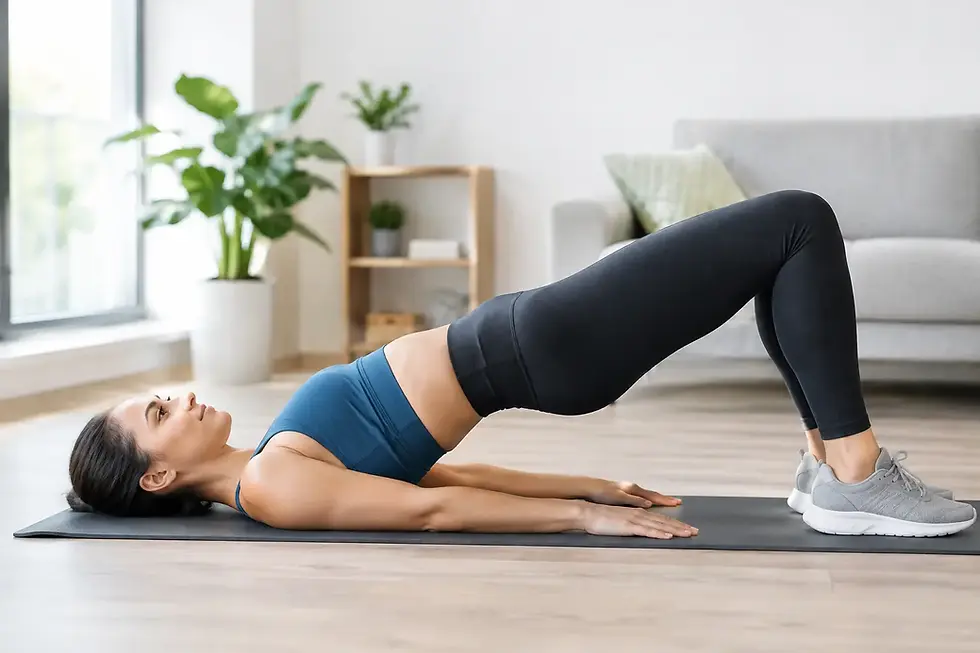
Try these: glute bridges (drive your hips up, hold two seconds, repeat 12–15 times), side-lying clamshells, and step-ups. Ten minutes, three times a week makes a measurable difference.
Foundation 2: Load Your Knees — Gradually and Consistently
Counterintuitive as it sounds, loading the knee is what keeps it healthy. The joint needs stimulus for cartilage nutrition and tissue strength. Complete rest accelerates decline — but how you load matters.
Try these: wall sits (hold 20–30 seconds), shallow squats with knees tracking over toes, and walking on varied terrain — grass and gentle hills challenge the stabilising muscles far more than a flat treadmill. If knee pain lasts longer than 24 hours after activity, ease off and get it assessed.
Foundation 3: Protect the Spine Through Core Endurance
"Core" doesn't mean crunches. The muscles that protect your spine are deep stabilisers — the transversus abdominis, multifidus, and pelvic floor — and they work by resisting movement, not generating it. Think guy ropes on a tent.
Try these: bird-dog (extend opposite arm and leg on all fours, spine still), dead bug (lower opposite arm and leg from a tabletop position on your back), and five minutes of morning mobility — cat-cow, thoracic rotations, hip circles. You'll notice the difference within two weeks.
Foundation 4: Don't Neglect the Shoulders
Shoulder pain is common in men over 40 who favour pushing exercises (press-ups, bench press) over pulling. The resulting imbalance drives the joint forward, compresses the structures within it, and sets the stage for impingement and rotator cuff problems.
Try these: band pull-aparts (pull a resistance band wide at shoulder height, squeezing shoulder blades together), face pulls with a band at head height, and thoracic extension over a foam roller. The simple rule: match every pushing exercise with a pulling one. Most people do three times as much pushing as pulling — close that gap.
The Lifestyle Foundations That Multiply Everything
Strength training works best when the wider lifestyle supports it. Three things make the biggest difference:
Sleep. Tissue repair — including cartilage, muscle, and tendon — happens during deep sleep. Adults who consistently sleep fewer than seven hours show accelerated musculoskeletal ageing. If pain is disrupting your sleep, that's a cycle worth addressing directly. It's something we see and treat in clinic regularly.
Protein intake. Muscle is built from protein, and most adults in their 40s and 50s eat significantly less than they need for maintenance, let alone building. Aim for at least 1.6g of protein per kilogram of bodyweight daily, spread across meals. This single change can dramatically improve your response to strength training.
Movement variation. The body adapts to repetitive loading and suffers from repetitive strain. If you sit at a desk for eight hours and then go for the same run every other day, you're loading the same structures the same way indefinitely. Vary your activities. Swim, cycle, walk, lift — the joints that stay healthiest are the ones that move in many directions.
When to Seek Professional Support
Strength training is powerful, but it works best alongside professional assessment if you're already experiencing symptoms. If you have joint pain that:
Persists for more than a week
Wakes you at night
Limits your normal daily activities
Is getting progressively worse
...then that's not a signal to push through. That's a signal to get it properly assessed. As osteopaths, we don't just treat the pain — we identify the underlying mechanical reasons why it's happening and build a plan to address the root cause, not just the symptom.
Many of the patients I see in Newbury and Hungerford have lived with niggles for months, sometimes years, convinced it's "just age." In the majority of cases, it isn't. It's addressable — often with a relatively short course of treatment and the right exercise guidance.
Your Starting Point
If you want to do one thing this week, let it be this: get on the floor and try a set of glute bridges. Ten repetitions, focusing on the squeeze at the top. If it feels unfamiliar or your lower back takes over, that's information. That's your body telling you where the work needs to happen.
Strength for longevity doesn't require a transformation. It requires consistency, the right guidance, and a genuine understanding that your joints — at 40, 50, 60 and beyond — are still entirely capable of being strong, stable, and pain-free.
You just have to give them the foundations.


Comments