

Sports Massage Versus Deep Tissue Massage

A tight calf before a long run, shoulders that ache after desk work, or a stubborn knot that returns every week can all make massage feel like the obvious answer. Yet when deciding between sports massage versus deep tissue, the best choice is not simply the treatment that feels strongest. It is the one that suits your body, your current symptoms and what you need to do next.
Both approaches can support mobility, ease muscular tension and help you feel more comfortable in everyday movement. Their focus, timing and techniques are different, however. Understanding those differences can help you choose care that supports lasting progress rather than simply chasing temporary relief.
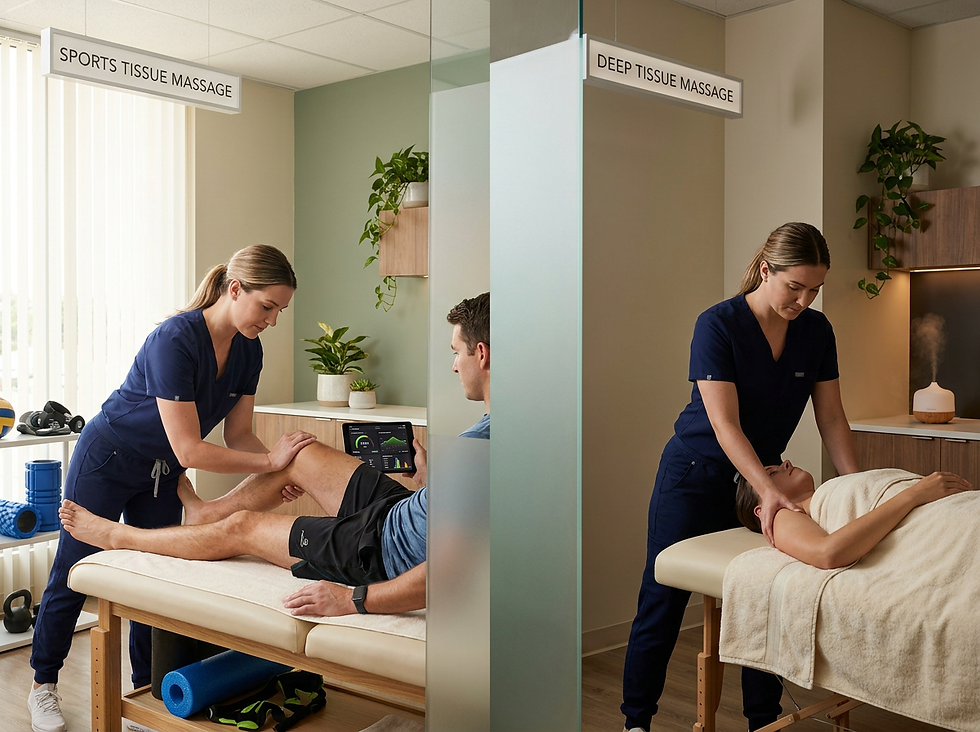
What is sports massage?
Sports massage is a tailored form of remedial massage designed around movement, activity and recovery. Despite its name, you do not need to be a competitive athlete to benefit from it. It can be helpful for anyone whose work, exercise routine or hobbies place repeated demands on their body.
A treatment may focus on muscles that are working particularly hard, areas of restricted movement, or patterns that are affecting how you walk, run, lift, cycle or train. For example, a runner may need attention around the calves, hips and glutes, while someone who spends much of the day at a computer may benefit from work through the neck, upper back, chest and forearms.
The pressure used in sports massage varies. Some sessions are energising and more brisk, particularly when used before an event or training session. Others are slower and more restorative, supporting recovery after activity. Your practitioner may use techniques such as effleurage, compression, stretching and focused soft-tissue work, always adapting them to your comfort and goals.
Sports massage is often chosen to support:
preparation for a period of training or an event
recovery after demanding exercise or physical work
improved flexibility and ease of movement
management of recurring muscular tightness linked to activity
awareness of movement habits that may be placing extra strain on the body
It is not a substitute for rest, progressive training or a carefully planned rehabilitation programme when these are needed. Instead, it can form one useful part of a wider approach to looking after your body.
What is deep tissue massage?
Deep tissue massage generally uses slower, more sustained pressure to work with deeper layers of muscle and connective tissue. The aim is not to apply as much force as possible. It is to work carefully with areas of persistent tension, thickness or sensitivity that may not respond well to a light, relaxing massage.
A deep tissue session may be appropriate when you have longstanding tightness around the shoulders, back, hips or legs, particularly where reduced movement has become part of daily life. Many people seek it when stress, posture, repetitive work or a previous period of inactivity has left them feeling restricted and uncomfortable.
Although the treatment can feel intense at points, it should remain manageable. Holding your breath, bracing against the pressure or feeling sharp pain is not a sign that the massage is working better. A skilled practitioner checks in, adjusts their approach and allows the tissues time to respond.
After deep tissue massage, it is common to feel tender for a day or two, much like the sensation after unfamiliar exercise. Gentle movement, hydration and avoiding a sudden return to heavy training can be sensible ways to support recovery. How you feel afterwards will depend on the area treated, the level of pressure, your general health and how much tension was present before treatment.
Sports massage versus deep tissue: the key difference
The simplest distinction is purpose. Sports massage is guided by your activity, movement demands and recovery needs. Deep tissue massage is guided more by the presence of deeper, persistent muscular tension and restricted tissue quality.
There is considerable overlap. A sports massage can include deep, focused work where it is appropriate, and a deep tissue massage may help an active person feel freer in their movement. This is why choosing from a service name alone can be misleading.
The more useful questions are: What is bothering you? When does it affect you? Are you preparing for activity, recovering from it, or trying to address a pattern that has been building over months? Your answers give a practitioner a far clearer starting point than simply asking for firm pressure.
For example, if you are increasing your running mileage and notice your calves becoming tight after longer runs, sports massage may be shaped around your training schedule, running mechanics and recovery. If your upper back has felt rigid for months after long working days, deep tissue techniques may be included to address the more established tension, alongside advice on movement and posture.
Is deeper pressure always better?
No. Firm pressure can feel satisfying, especially when an area seems knotted or congested, but more pressure does not automatically mean more benefit. Muscles can tighten further when the body perceives a treatment as too aggressive. The right level is one that allows you to stay relaxed enough for the work to be productive.
This is particularly relevant if you are already stressed, fatigued, sensitive to touch or experiencing widespread tension. A gentler approach may be more appropriate at first, with treatment building gradually as your body becomes more comfortable. Equally, someone who regularly trains and understands how their body responds may prefer more focused work in specific areas.
Good massage should be collaborative. Let your practitioner know if the pressure feels too much, if a sensation travels, or if you feel sore for longer than expected after a previous session. Those details help shape a plan that is effective and sustainable.
Choosing the right massage for your situation
If your concern is connected to a particular sport, physical goal or training routine, sports massage is often a sensible place to start. It offers space to consider the demands of your activity rather than treating the painful area in isolation. A tailored session can also help you notice whether tightness is related to workload, recovery, footwear, technique or a lack of variation in your movement.
If your main concern is long-term muscular tension, reduced flexibility or a feeling that certain areas have become chronically stiff, deep tissue massage may be more suitable. It can be particularly useful when the aim is to work patiently through a persistent pattern rather than prepare for or recover from a specific activity.
Sometimes the answer is neither label on its own. If pain is recurrent, significantly limiting your movement, affecting sleep, or returning despite massage, a broader assessment may be valuable. Osteopathic care can look at how joints, muscles, posture, daily habits and movement patterns are interacting, with massage, rehabilitation and corrective movement used as part of a personalised plan where appropriate.
At Laura Fishlock Osteopathy, treatment is guided by what your body needs now and what will help you regain confidence in movement over time. That may mean focused massage, practical mobility work, pacing advice or a combination of approaches.
What to expect at your appointment
Your session should begin with a conversation, not an assumption. Your practitioner will ask about your symptoms, activity levels, medical history and what you would like to achieve. They may also assess how you move and identify areas that appear to be working harder than they need to.
Wear comfortable clothing and be open about recent training, injuries, medication and any changes in your health. You should also mention if you are pregnant, have a fever or infection, have recently had surgery, or have a history of blood clots, circulation concerns or unexplained swelling. Massage is not appropriate in every circumstance, and adapting or postponing treatment can be the safest choice.
The treatment itself should have a clear intention. You may be offered advice on gentle movement, rest, stretching or how to return to exercise gradually afterwards. This is not about giving you a long list of tasks. It is about providing realistic support that fits your routine and helps the benefits of hands-on treatment carry into daily life.
Let your goals lead the choice
Whether you choose sports massage, deep tissue massage or a more integrated assessment, the aim is to feel better equipped to move through life with less restriction. The most helpful treatment is rarely the toughest one. It is the one that listens to your goals, respects your body’s signals and supports the steady return of strength, mobility and ease.


Comments